Brands Are Hesitating on Sustainability. The Boldest Are Playing to Win.

More than just “doing the right thing,” sustainability is a condition for staying competitive. An asset. It helps businesses spot vulnerabilities, build resilience and adapt. Still, most brands are playing not to lose. They use sustainability defensively, to live up to regulation and shield the business from geopolitical shocks. For them, sustainability is about mitigating risk. Meanwhile, the strongest brands are playing to win. They still manage risk. But they also use sustainability to create competitive advantage, shape perception and strengthen how the company is understood.
While political priorities shift, the forces behind sustainability stay put. Climate change, geopolitical instability, resource constraints and social inequality show up as price volatility, supply chain disruption, regulatory change and new stakeholder expectations. More and more, the brands that see the long game and are brave enough to play it, are the champions.
But figuring out which position to play is getting harder to read. The effects of climate change are more tangible every year, and scrutiny from consumers and regulators keeps rising. At the same time, sustainability has become divisive; the EU Omnibus has scaled back corporate reporting requirements, and geopolitics is taking precedence. Many brands have responded by greenhushing and lowering the volume on their sustainability positioning.
What separates playing to win from playing not to lose is not how much brands say about sustainability. It is the role they give it, the language they use and how prominently they place it within the company.
Four narratives. Two directions. Not equally effective.
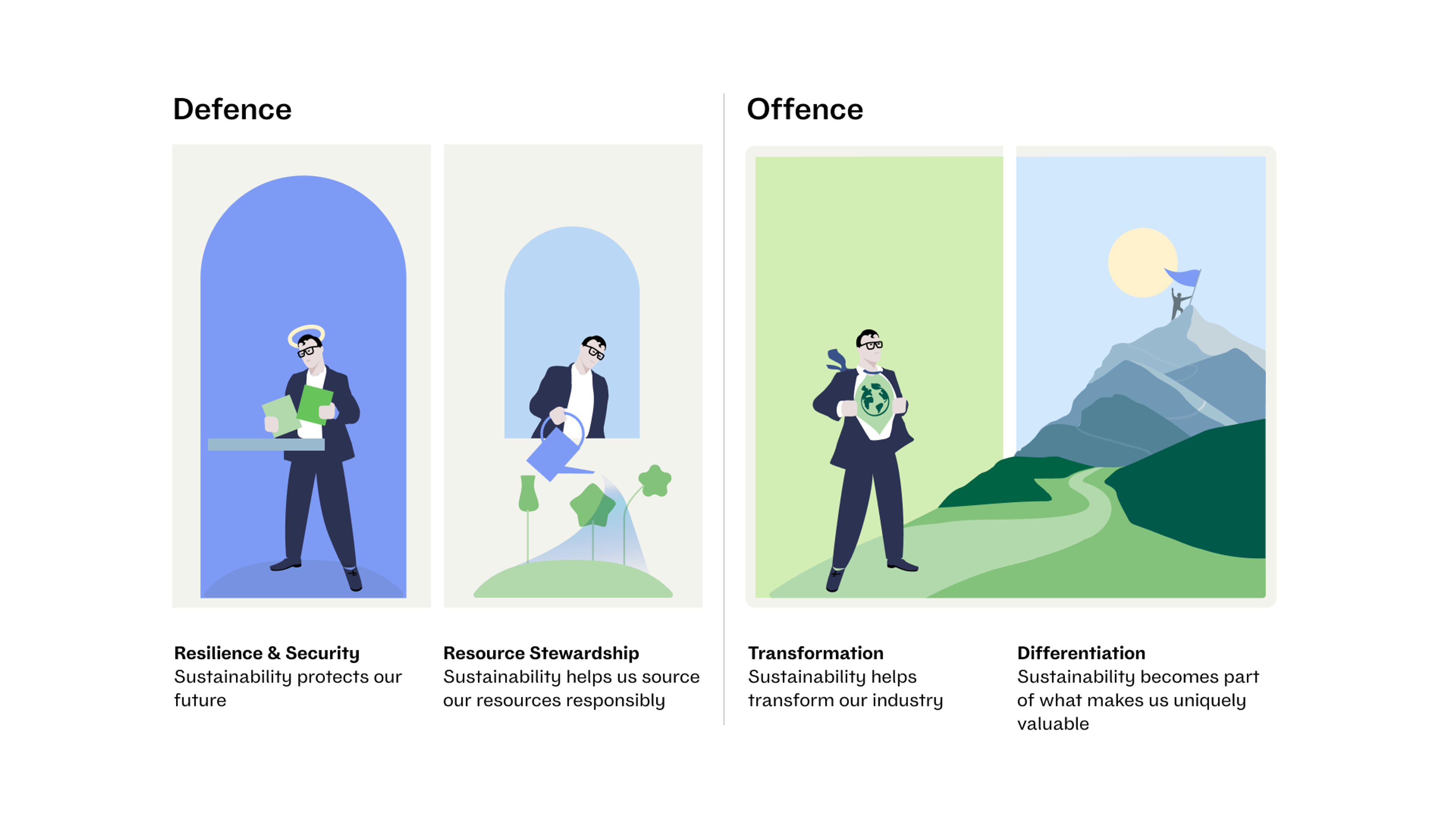
Companies tend to frame sustainability in one of four ways: resilience and security, resource stewardship, transformation, or differentiation. The first two play defence. The last two play offence.
Caught between inflammatory rhetoric and tighter regulation, most brands have retreated to a defensive position. Resilience and stewardship let a company advance its goals without taking a stance on a contested topic. They also offer cover against accusations of greenwashing. It’s a reasonable position, one that puts points on the scoreboard, but it’s rarely a winning strategy.
“
The brands that communicate sustainability most effectively go beyond framing sustainability through risk mitigation into offensive narratives. They use sustainability to change the rules of the game, or to become the player everyone has to reckon with.
They present sustainability as a driver of transformation and differentiation leveraging this to create competitive advantage. Rather than focusing solely on what must be protected, they emphasize what can be gained through leveraging their sustainability in communications.
Offence is not about turning up the volume.
Playing to win is not about shouting louder or doing more. It is about the importance and visibility sustainability is given, and whether it works actively for your brand.
This requires balancing substance with inspiration. Concrete proof establishes credibility. Emotional resonance captures attention, shapes memory and drives preference. When two companies state virtually identical claims, how the story is told decides whether one inspires while the other falls flat.
Category dynamics play a pivotal role. A daily essential cannot carry the same narrative weight as a high-end luxury good. For decisions rooted in desire and self-expression, sustainability integrates seamlessly into an aspirational positioning. Where functionality dominates, emotional territory shrinks. Yet a narrower space is not a nonexistent one. For functional offerings, offensive strategy means positioning sustainability as the key to superior quality, durability or trust – reinforcing the broader brand narrative rather than attempting to replace it.
Being responsible is expected. Being better is chosen.
Regulation has raised the floor. Most European brands now meet a baseline of sustainability compliance, which makes responsible practice an expectation rather than a differentiator.
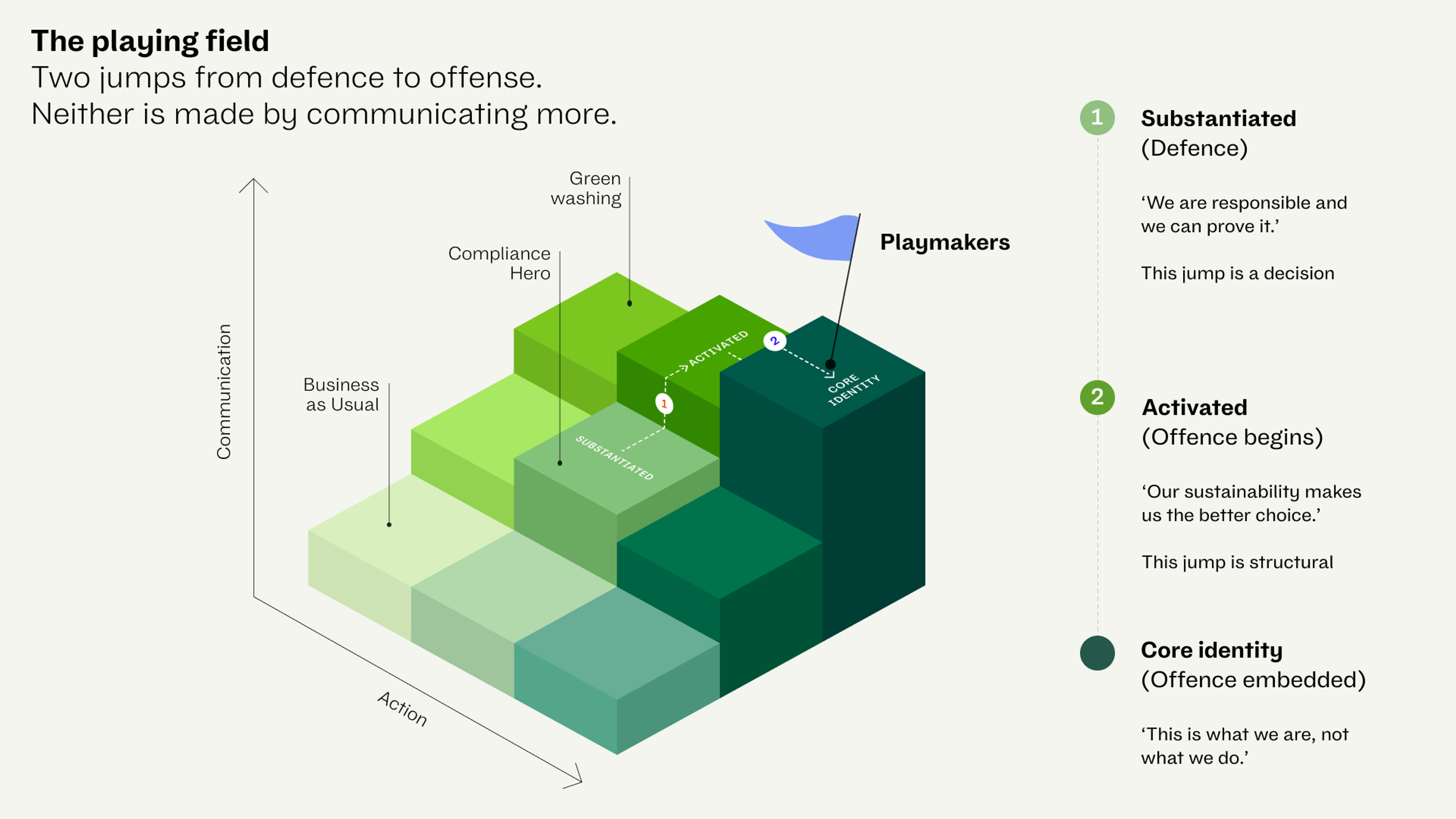
As illustrated, what separates Playmakers from Compliance Heroes is not the amount of work being done. It is the importance and visibility sustainability is given. The strongest brands make it inseparable from who they are, and that is hard for competitors to copy.
Two jumps, not one.
Brands move across the field in three stages. First, they substantiate: they prove their claims and earn credibility. This is defence. Then they activate: they make sustainability relevant, desirable and emotionally resonant. This is where they start playing offence. Finally, sustainability becomes core identity. It shapes how the business is understood, not just what it does.
The first jump is a decision: choosing to use sustainability to change the game, not just to stay in it. The second jump is structural: sustainability has to be embedded deeply enough in the product, business model or competitive position that it can no longer be separated from the company.
How to play to win.
The progression is not from weak to strong communication. It comes from earning a place on the field, to becoming the team to beat, to rewriting the rules.
The companies furthest ahead have made sustainability part of how they compete and create value. Their sustainability communications stop being decoration. They become a way of asserting what sets them apart and how they win – or intend to.
So the question for most brands is no longer whether to communicate sustainability but rather which jump is your brand ready to make?
Looking to level up your brand? Don't hesitate to reach out.

Senior ESG Communication Strategist
Andre Sanchez Montoya